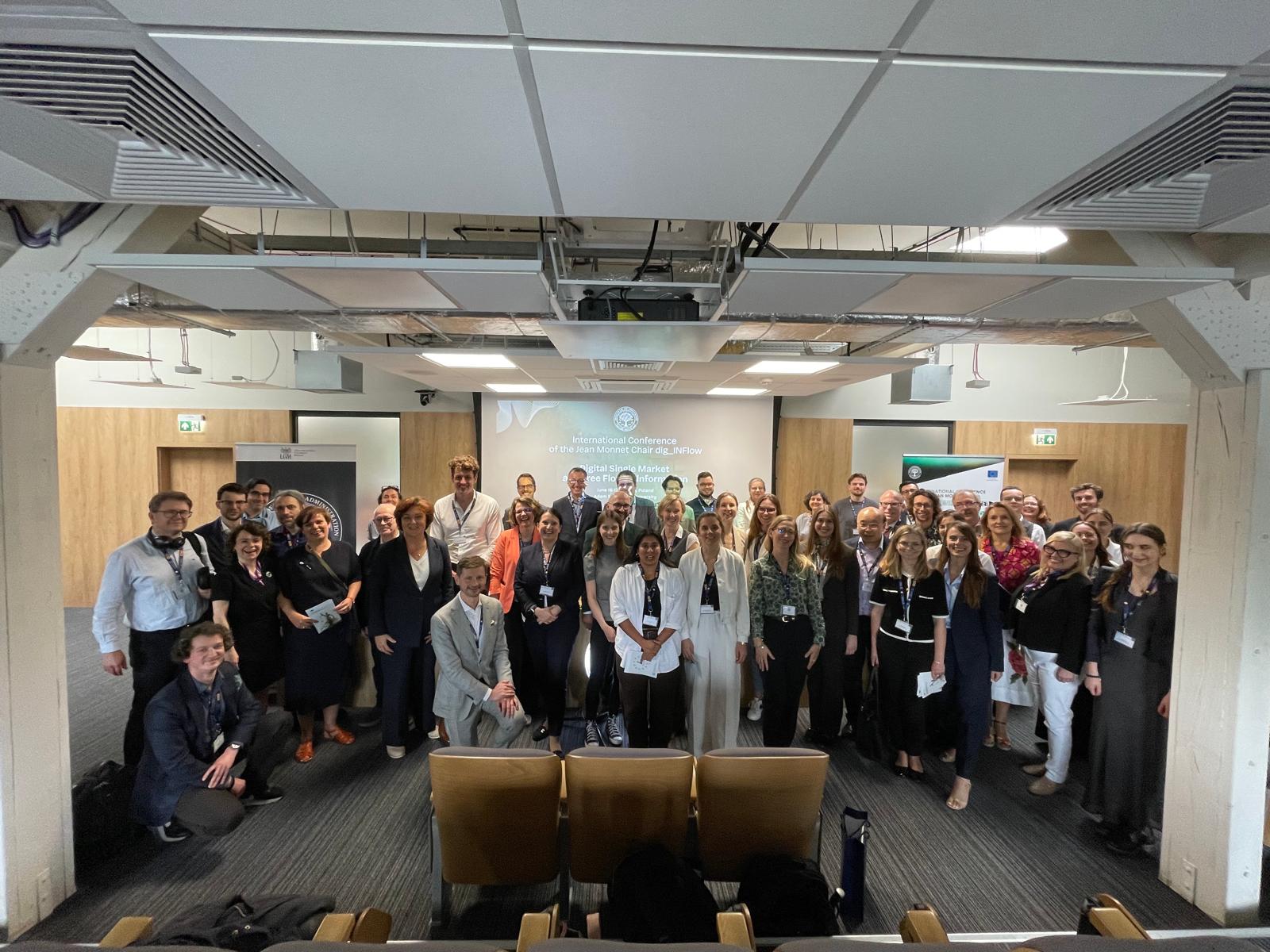

International scientific conference – Digital Single Market and the Free Flow of Information June 16-17th 2025
International scientific conference
Digital Single Market and the Free Flow of Information
June 16-17th 2025.
Video recordings summarizing the conference proceedings, are now available!
[links below]
This interdisciplinary conference, at the Faculty of Law and Administration, Adam Mickiewicz University in Poznań concluded the activities of the Jean Monnet Chair dig_INFLow. It offered the possibility to deepen and discuss the areas explored for three years, during the project. The conference was held under the patronage of the Polish Presidency of the European Union; the honorary patronages from Polish Patent Office and the Consumer and Competition Protection Authority. Partners of the Conference included ASCOLA (The European Chapter) and Neuroscience Center at Adam Mickiewicz University. The program of the conference was prepared with the support of the Scientific Committee of the conference, featuring: Prof. Maria Lilla Montagnani ( Università Bocconi), Prof. Alberto de Franceschi (Università degli Studi di Ferrara) Prof. Martin Senftleben (Universiteit van Amsterdam) Prof. Pieter van Cleyenbreugel (Université de Liège) dr Hannah Thornton (Noerr PartGmbB).
The first panel, facilitated by the representative of the Legal Service of the European Commission Mrs Agnieszka Stobiecka-Kuik, on Past, Present and Future of the Digital Single Market set the scene for the two – day interdisciplinary proceedings; with speeches by Mrs Rita Wezenbeek, responsible for platform policy and enforcement in the DG Connect, European Commission and dr Michał Boni, former deputy to the European Parliament and Minister of Administration and Digitization.
The highlights are available at AMU Youtube channel: https://www.youtube.com/watch?v=LBLHLcASWsw
The first day of the conference was dedicated to the leading topics of the Jean Monnet dig_INFLow Chair: intersection of new technologies, media and information flows, competition on digital markets and protection of consumers. Full agenda of the conference is available here: https://freeflow.web.amu.edu.pl/#agenda
Distinguished academic speakers of the panels included: prof. Martin Senftleben, (Director of the Institute for Information Law at University of Amsterdam), Dr Małgorzata Kozak (Utrecht University), Prof. Maciej Bernatt (University of Warsaw and Director of the Centre for Antitrust and Regulatory Studies), Dr. Kati Cseres (Associate Professor of Law at the Amsterdam Centre for European Law and Governance), Prof. Ondrej Blažo (Comenius University Bratislava), Prof. Emilia Mišćenić (University of Rijeka), and Prof. Monika Namysłowska (University of Łódź).
The first presentation of each panel was recorded and is now available online:
Panel: Single Market, Media Information and Law
Martin Senftleben, University of Amsterdam
The copyright / DSA / AI Act regulatory thicket in the EU: Freedom of information challenges and opportunities
Panel: Interplay between EU Competition Law, Digital Markets Act (DMA), and the Free flow of Information
Maciej Bernatt, University of Warsaw
Competition – democracy – human rights: Protecting pluralism and health in digital age
Panel: Digital Single Market and Consumers
Emilia Mišćenić, University of Rijeka
Towards digital fairness: Is EU consumer law fit for purpose?
These excellent talks were complemented by views from the participants selected in the course of the open call for papers: dr Dominika Kuźnicka-Błaszkowska (Wrocław University), Jacob van de Kerkhof ( University of Utrecht PhD Candidate) dr Katarzyna Sadrak, (European Commission), dr Iga Małobęcka-Szwast (University of Warsaw), dr Klaus Wiedemann (Max Planck Institute for Innovation and Competition in Munich), dr Adrianna Michałowicz (University of Łódź) and dr Julija Kalpokienė (Vytautas Magnus University) joining the conference online.
Neurodata and Neurorights – 17th June
Day‑two report available here: [YouTube link]
The second day opened with a workshop delivered as part of the third edition of the Faculty’s SICSS‑AMU/Law Summer School – Summer Institute in Computational Social Science. Mikołaj Ryśkiewicz (PhD candidate, University of Warsaw) demonstrated how, using Python and data from the ELI API, one can analyse hundreds of thousands of Polish statutes. Live results debunked the popular “legislative inflation” myth: 90 % of statutes enacted since 2015 are amendments, and after excluding consolidated texts the effective body of binding law is seven times smaller. Ryśkiewicz stressed that today the real bottleneck is not data availability but lawyers’ lack of programming skills and ability to perform replicable analyses.
The keynote lecture featured: dr Marcin Naranowicz (AMU Cognitive Neuroscience Center, and Department of Psycholinguistic Studies of the Faculty of English) and Dr Hannah Thornton (Noerr PartGmbB). Dr Marcin Naranowicz explained why EEG remains a key tool in both clinical research and commercial brain–computer interfaces. He presented striking data: positive mood amplifies, while negative mood weakens, the brain’s automatic response to stereotypical phrases, allowing deep mental states to be discerned and offering a “peek inside” the mind. Dr Hannah Thornton outlined the legal implications: invasive brain‑computer interfaces are already regulated under EU law, e.g. the Medical Devices Regulation (MDR) and the Cyber Resilience Act, which mandates “security by design”. The AI Act introduces bans on emotion recognition in workplaces and schools. A key issue, Thornton noted, is the absence of a clear “neural data” category in the GDPR – EEG data straddles “health data” and “biometric data”.
In a debate moderated by Dr Łukasz Szoszkiewicz (NeuroRights Foundation, AMU), participants agreed that innovation and fundamental rights must coexist. Among the points raised:
• Prof. Peter Yu (Texas A&M) warned that neuro‑tech could widen the “computational divide” between the Global North and South.
• Marta Pych (Polish Data Protection Authority) highlighted the difficulty of anonymising continuous EEG signals and classifying neural data under the GDPR.
• Dr Stephen Damianos (Neurotechnology Center, Columbia) presented five “neurorights” already being incorporated into legislation in Chile and Spain.
• Dr Mikołaj Buchwald (Poznań Supercomputing and Networking Center) cautioned against labelling every brainwave as “sensitive data”, which could stifle economic innovation and scientific progress.
Full recording of Day 2: https://www.youtube.com/watch?v=9CwOfttgJ4c&t=8802s
The full report from the conference proceedings will soon be published!